The transaction
Building a Rental Property Portfolio: A Step-by-Step Guide
A purchase is a sequence of checks, not a single decision. Knowing the order matters, because the money and the commitment enter at different stages.
Building a rental property portfolio starts with defining your investment goals, choosing a market and property type, securing financing, and then scaling through repeatable systems. A portfolio is simply a collection of real estate investments—residential, commercial, multi-family, or land—that you own to generate income and build wealth. The process begins with one property and grows through deliberate decisions about strategy, location, and management. This guide walks through each step, from setting your financial targets to managing a growing portfolio, so you can build wealth through real estate with confidence.
Define Your Investment Goals and Strategy
Before buying any property, clarify what you want from real estate. Are you seeking monthly cash flow, long-term appreciation, or a mix of both? Cash flow investors prioritize properties that generate positive net income after all expenses, while appreciation-focused investors accept lower initial returns in exchange for potential value growth over time. Your timeline also matters: some investors plan to hold for decades, while others aim to refinance or sell within a few years. Document specific targets, such as acquiring three single-family rentals in five years or achieving $2,000 in monthly net cash flow within a decade, to create a filter for evaluating opportunities.
Your risk profile influences property type and market choice. For example, short-term rentals can yield higher gross income but come with regulatory and demand volatility, while long-term leases offer more stability. Decide how hands-on you want to be: self-managing saves money but demands time, while hiring a property manager adds costs but frees you from day-to-day tasks. Factor management fees into your projections from the start if you plan to delegate.
Choose the Right Market and Property Type
Location often determines success more than the property itself. Look for markets with job and population growth, high renter-to-owner ratios, low vacancy rates, and rising rents. Neighborhood quality—schools, transit, and proximity to employers—also drives demand. You don't have to invest locally; many investors expand to out-of-state markets with stronger fundamentals, but apply consistent criteria to compare areas fairly. Be aware of local regulations, such as rent control or short-term rental restrictions, which can significantly impact returns.
Property type shapes your workload and returns. Single-family homes are simple to manage and appeal to families but may have higher vacancy risk if a tenant leaves. Condominiums offer lower maintenance through HOA coverage but come with fees and rules that can reduce profits. Multi-family properties (2–4 units) can accelerate portfolio growth by adding multiple income streams under one roof, though they may require more management. Diversifying across property types and locations can spread risk, but starting with one type in a familiar market often makes sense for new investors.
Secure Financing and Leverage Equity
Financing is a common hurdle when scaling. Many investors use equity from an existing property to fund the next purchase, either through a cash-out refinance, home equity line of credit, or cross-collateralization. Partnerships and private lenders can also provide capital, but they come with trade-offs in control and profit sharing. The BRRRR method—buy, rehab, rent, refinance, repeat—is a popular strategy for recycling capital: you improve a property, rent it out, refinance to pull out equity, and use that money for the next deal. However, this approach requires careful underwriting to ensure the property's after-repair value supports the refinance.
Lenders evaluate your debt-to-income ratio, credit score, and the property's income potential. For rental properties, they often consider projected rental income and may require a debt service coverage ratio (DSCR) above 1.25, meaning the property generates at least 25% more income than its debt payments. Keep your personal finances strong and maintain reserves for vacancies and repairs to qualify for favorable terms.
Build Systems for Management and Scaling
As your portfolio grows, you need repeatable systems to handle tenant screening, rent collection, maintenance, and accounting. Property management software can automate many tasks, or you can hire a professional manager. A good manager handles leasing, tenant communication, and maintenance coordination, freeing you to focus on strategy. However, management fees typically range from 8% to 12% of monthly rent, so weigh the cost against your time and expertise.
Track key metrics for each property: cash flow, cap rate (net operating income divided by property price), cash-on-cash return (annual pre-tax cash flow divided by initial cash invested), and vacancy rate. Regularly review these numbers to identify underperforming assets and make data-driven decisions about renovations, rent adjustments, or sales. Standardizing your processes—from lease agreements to vendor lists—also makes it easier to onboard new properties and maintain consistency.
Scale Strategically and Manage Risk
Scaling isn't just about buying more; it's about buying right. Concentrating properties in one geographic area can create economies of scale and local market knowledge, but it also exposes you to area-specific risks like natural disasters or regulatory changes. Diversifying across markets and property types can mitigate risk but may increase management complexity. Consider your capacity: if you're self-managing, adding too many properties too quickly can lead to burnout and neglect. Many investors hit a point where hiring a property manager or building a team becomes necessary.
Monitor market trends and be willing to pause when conditions are unfavorable. For example, rising interest rates can reduce cash flow and make refinancing less attractive. Keep reserves for unexpected expenses—a common rule of thumb is to set aside 1% to 3% of the property value annually for maintenance and capital expenditures. Finally, remember that a smaller portfolio of well-performing properties can be more valuable than a large portfolio of mediocre ones. Focus on quality and alignment with your goals.
Common Questions About Rental Property Portfolios
Investors often ask about rules of thumb for evaluating rental properties. The 50% rule suggests that operating expenses (excluding mortgage) will consume about 50% of gross rental income over time, though actual expenses vary by property age and location. The 2% rule states that monthly rent should be at least 2% of the purchase price for strong cash flow, but this is rarely achievable in high-cost markets. The 1% rule is a more realistic benchmark in many areas. These rules are heuristics, not guarantees, so always run detailed numbers for each deal.
Building a rental property portfolio is a long-term endeavor that rewards patience, discipline, and continuous learning. Start with a clear strategy, choose your market and property type wisely, secure financing that aligns with your goals, and build systems that allow you to scale without sacrificing quality. By making informed decisions at each step, you can create a portfolio that generates passive income and builds lasting wealth.
Sources
- How to Scale From One Rental Property to a Portfolio
- 10 Steps to a Winning Rental Property Investment Strategy
- What is a real estate portfolio and how to build one
- Building Your Commercial Real Estate Portfolio
Viewing, and what a viewing can tell you
A viewing is good at answering questions about layout, light, noise and the immediate surroundings. It is poor at answering questions about structure, damp, services and boundaries, because those are either hidden or slow to reveal themselves. Treat the visit as a test of whether the plan works for the household, and leave the building's condition to a later stage.
Visiting twice, at different times of day and week, answers more questions than any single long visit.
The offer
An offer is a proposal, and in most systems it binds nobody. It carries two kinds of information: the figure, and the position of the buyer — whether they have a property to sell, how their purchase is funded, and how quickly they can move. Sellers weigh both, and often weigh the second more heavily than buyers expect.
Once an offer is accepted the property is usually described as under offer or sold subject to contract. Neither phrase means the sale is agreed in any binding sense.
Legal work and enquiries
After acceptance the legal stage begins. It establishes who owns the property, what precisely is being sold, what rights and obligations come with it, and what the public record says about the land and the area around it. This is where searches are carried out and where questions are put to the seller's side.
This stage is where most delay lives, and most of it is waiting for third parties rather than work being done slowly.
Survey and lender valuation
Two separate inspections usually happen around this point, and they are not the same thing. A lender's valuation protects the lender's security. A survey commissioned by the buyer reports on the condition of the building for the buyer's benefit. One is not a substitute for the other.
A survey that identifies work is not a reason to stop; it is information about cost and timing that did not exist before.
Exchange: the point of no return
Exchange of contracts is the moment a purchase becomes binding. Before it, either side can generally walk away and lose only what they have already spent. After it, walking away has serious financial consequences. Everything that needs to be known should be known before this point, not after it.
Completion, and afterwards
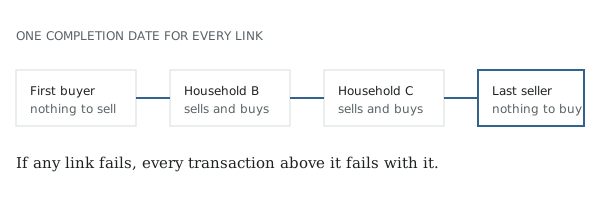
Completion is the transfer of money and possession, usually on a date agreed at exchange. Where the purchase sits in a chain, completion has to be coordinated with every other transaction in it, which is why dates are negotiated as carefully as figures.
After completion the ownership record is updated and any tax on the transaction is dealt with. These are administrative rather than uncertain, but they are not instantaneous.